How six southeastern Ontario hospitals reduced clinicians’ report burden
By Kathy Tudor, Director, Marketing & Communications, OntarioMD
Featured in Canadian Healthcare Network, "Doctor Daily Newsletter", April 18, 2026.
HIRAC: Driving HRM Task Force Recommendations
Clinicians have been clear: the status quo for Health Report Manager (HRM®) isn't good enough. The HRM Task Force mapped out the fixes—now it's the
HRM Improvement Recommendations Advisory Committee's (HIRAC) role to make sure those solutions actually happen.
HIRAC brings hospitals and EMR vendors to the table to encourage them to move ahead with the improvements clinicians have been calling for. HIRAC is tracking their progress to ensure that changes translate into real, tangible improvements in the clinical workflow.
This isn't just oversight—it's advocacy. It's insisting that the burden placed on clinicians is unacceptable and that the system must respond with urgency. HIRAC is moving the sector from taking action "someday" to concrete timelines, clear responsibilities, and measurable progress.
For clinicians, this means someone is championing the changes that will streamline documentation, reduce frustration, and support better patient care. HIRAC is making sure that the HRM Task Force's work doesn't sit on a shelf—it becomes action, impact, and a better experience for those on the front lines.
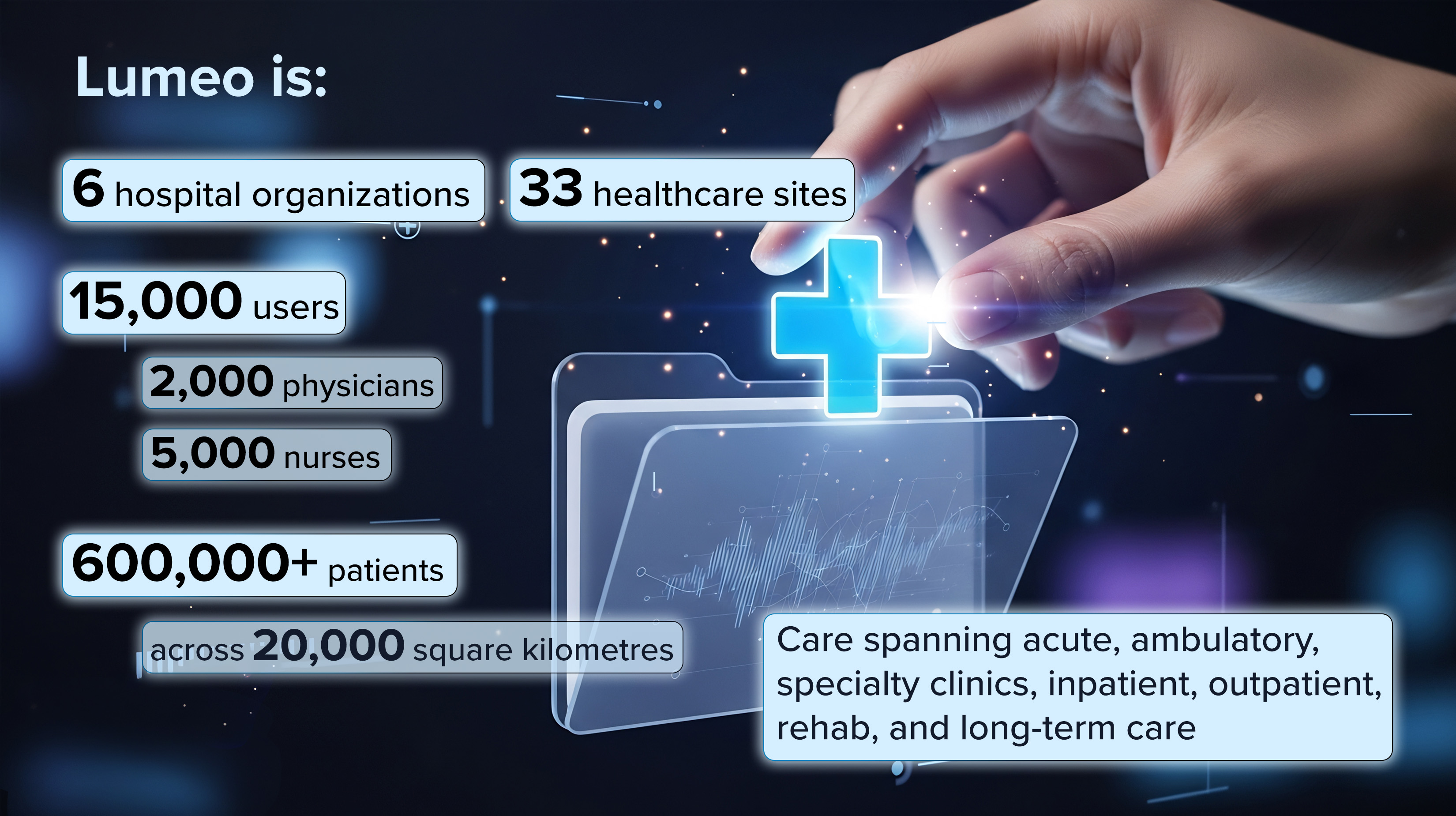
What happens when six hospital organizations partner together to create one shared digital health information system to better serve their community? In Southeastern Ontario, that transformation is underway with the consolidation of 33 healthcare sites into a unified regional health information system (HIS) known as
Lumeo. Part of this transformation includes working with
OntarioMD to advance the benefits of
Health Report Manager (HRM®), a digital health tool that delivers hospital reports to clinicians' electronic medical record (EMR) systems, reducing administrative burden and finding solutions for what many call "a wicked problem".
Lumeo is connecting people and care teams from Brockville General Hospital, Kingston Health Sciences Centre, Lennox & Addington County General Hospital, Perth and Smiths Falls District Hospital, Providence Care, and Quinte Health. It facilitates better, faster information sharing, enhancing care quality and reducing redundancies.
While the scope of this project is one of the most ambitious in the province, the volume, quality and reliability of clinical reports sent through HRM demanded early attention.
The wicked problem
For years, clinicians in the region have dealt with faxes, snail mail, inconsistent formatting, duplicate reports, and missing documentation. The transition to a fully electronic HIS amplified those challenges. As more report types were digitized and automatically distributed, it led to a dramatic increase in HRM report volume.
As Dr. Siddhartha Srivastava, Regional Chief Medical Information Officer (CMIO) explains, report distribution is “a wicked problem”—complex, interconnected, with shifting requirements across multiple interest holders and no single quick fix.
“Good solutions to wicked problems require systems thinking with an iterative continuous improvement mindset and intense collaboration and dialogue across hospitals and community practices,” he says. “We have spent time building relationships with community practices and have made good progress in our report delivery problems."
OntarioMD convened an HRM Task Force to address the issues at the hospital and EMR ends of the delivery process. The Task Force made
several recommendations and the Lumeo team partnered with OntarioMD, Ontario Health Teams and primary care clinicians to come up with solutions —leading to changes on how to define which notes should be distributed, how to standardize naming conventions, and how to reduce unnecessary and duplicate reports. The results were immediate with more than 5,000 duplicate clinical notes eliminated in one month, according to Lumeo data, with an average reduction of 236 duplicate notes per day across the region.
Solutions = technology + people + partnerships
The Lumeo team and their partners didn’t just rely on technical solutions. Their transformation blended system reconfiguration, workflow redesign, and deep human collaboration. The work was also facilitated with guidance from the Frontenac, Lennox & Addington Ontario Health Team (OHT), one of the leading OHTs in the province with a more developed Primary Care Network (PCN).
“When you’re moving six healthcare organizations and 33 sites onto a single digital platform, report distribution isn’t a technical issue, it’s a system issue. It affects hospital workflows, primary care practices, and ultimately, the people we serve,” says Leon Goonaratne, Lumeo’s Regional Vice-President. “The only way to solve it is together. Our collaboration with primary care leaders, Ontario Health Teams, and OntarioMD has helped us in redesigning how information flows across the region.”
Lumeo has developed a direct feedback channel with primary care clinicians in the region, facilitating communications around report issues, which gives the operations team valuable information for investigating and solving problems. They also introduced a Primary Care Medical Lead, Dr. Daniel Glatt, who has been integrated into Lumeo’s governance structure to provide expertise and to advocate for community clinicians. “A family medicine practice is the patient’s medical home,” says Dr. Glatt. “Effective communication between hospitals and community clinicians is crucial for the patients we serve. By including family medicine in the governance structure, we can continue to build a system that works for all parts of the patient’s healthcare journey.”
OntarioMD stepped in with report distribution setup during the migration and joint work on the HRM Optimization Trial, where reports routed through HRM used AI to produce a summary of the reports on the first page. Joint planning is also underway for future HRM enhancements.
Looking ahead: local success to guide provincial change
Since Lumeo’s Go-Live, duplicate reports have been reduced dramatically, and work is underway to manage other issues, while piloting new projects, such as distributing new types of reports through HRM. The regional team is working on further standardizing note types and addressing complex situations where clinicians practice both within the hospital and as community specialists.
The work and ongoing partnerships prove what’s possible when hospitals, primary care, OHTs, and OntarioMD work together toward a shared goal: reducing burden for clinicians and improving care for patients. “People and organizations have come together for a shared vision of high-quality care for the people we serve,” says Goonaratne. “I’m really proud of the inclusion of the community in our governance model, as it allows us to hear their perspectives and continuously improve."
Footnote:
If your OHT, PCN, or hospital is looking to find solutions to improve digital reports through HRM for clinicians in your area, check out the HRM Task Force’s
Sending Facilities Recommendations and connect with OntarioMD at
support@ontariomd.com. OntarioMD welcomes the opportunity to collaborate with you and advocate for technology and process improvements that lead to tangible results.